The Central Kalahari Game Reserve is one of Africa’s most extraordinary and least-visited wilderness areas — a vast, semi-arid expanse covering 52,800 km² in the heart of Botswana, making it the second-largest game reserve on Earth. Larger than the Netherlands, it offers something increasingly rare on the continent: genuine solitude, untamed desert landscapes, and wildlife encounters without another vehicle in sight.
Key Takeaways
- The Central Kalahari Game Reserve covers 52,800 km² — the second-largest game reserve in the world, larger than the Netherlands
- Established in 1961 to protect both wildlife and the traditional lands of the San people (Bushmen)
- Famous for the iconic black-maned Kalahari lion, cheetah, brown hyena, gemsbok, and massive seasonal migrations of springbok and wildebeest
- Deception Valley — a fossilised ancient riverbed — is the reserve’s wildlife heart, drawing predators and prey after the summer rains
- Best visited during the green season (December–April) for dramatic predator action, or in the dry season (May–October) for easier game viewing on the pans
- Low malaria risk compared to northern Botswana, and one of the most remote, crowd-free safari destinations on the continent
What Is the Central Kalahari Game Reserve?
The Central Kalahari Game Reserve (CKGR) is a protected wilderness area in central Botswana, proclaimed in 1961 with a dual mandate: to protect the region’s remarkable desert-adapted wildlife and to preserve the ancestral lands of the San people (also known as the Bushmen), one of the world’s oldest indigenous cultures. At 52,800 km², it dwarfs most national parks — roughly four times the size of South Africa’s Kruger National Park.
Unlike the Okavango Delta or Chobe, the CKGR is not wet and lush. It is a fossil desert — ancient riverbeds, calcrete pans, open grasslands, and sparse acacia scrub stretching to every horizon. The Kalahari is technically a “fossil desert” because, while it receives enough rain to support vegetation and wildlife, its deep Kalahari sand still defines the landscape. This is a place where the sky dominates as much as the land, and where the silence is almost physical.
What Wildlife Can You See in the Central Kalahari?
The CKGR’s signature species is the black-maned Kalahari lion — a distinct ecotype of the African lion, notable for its darker, fuller mane and adapted to the harsh desert conditions. These lions roam vast territories and are among the most photogenic big cats on the continent. Predator sightings can be exceptional when wildlife concentrates on the pans.
Beyond lions, the reserve supports a rich cast of desert-adapted wildlife:
- Cheetah — one of the best places in southern Africa to observe cheetah hunting on open plains
- Brown hyena — a shy, rarely-seen species that is more reliably encountered here than almost anywhere else
- Gemsbok (oryx) — the Kalahari’s most iconic antelope, with striking black-and-white facial markings and long straight horns, built for desert survival
- Springbok — huge herds gather during the green season, sometimes tens of thousands strong, drawing predators in their wake
- Wildebeest — seasonal aggregations that rival the movements of the Serengeti in scale, if not in spectacle
- Wild dog (African painted wolf) — occasional sightings; packs move through the reserve’s vast territories
- Meerkat — habituated meerkat groups near certain camps offer remarkably intimate encounters
- Bat-eared fox, aardwolf, porcupine, honey badger — the CKGR’s night drives are renowned for unusual small-mammal sightings
Elephant and buffalo are generally absent — the CKGR is not a Big Five destination in the conventional sense. This is not a weakness; it is the reserve’s character. The CKGR rewards patience and a different kind of safari curiosity — one attuned to space, adaptation, and predator-prey dynamics on an immense scale.
Where Is Deception Valley and Why Does It Matter?
Deception Valley is a fossilised ancient riverbed — once a flowing river channel, now a long, shallow, grass-covered fossil valley in the northern CKGR. After the summer rains, it fills with green grass and wildflowers, and the wildlife concentrations here can be extraordinary. Springbok and gemsbok pour onto the valley floor; predators follow. It is the ecological heart of the reserve and the setting for Mark and Delia Owens’s celebrated memoir Cry of the Kalahari, which brought global attention to this remote wilderness.
The name “Deception Valley” was coined by the Owenses because the valley appeared to hold water from a distance but offered none on closer inspection — a Kalahari mirage. Game drives in and around the valley in the green season offer some of the most cinematic wildlife viewing in southern Africa: vast open skies, golden grasses, predator hunts unfolding across flat terrain with no obstructions.
When Is the Best Time to Visit the Central Kalahari?
The CKGR has two distinct seasons with very different characters — and the “best time” depends entirely on what you’re looking for.
Green Season: December to April
The green season follows the summer rains and is widely considered the most dramatic time to visit. The pans and fossil valleys fill with new grass, attracting enormous herds of springbok, wildebeest, and gemsbok. Predators — particularly black-maned lions and cheetah — are active and highly visible, hunting in the open. The landscape turns vivid green against red Kalahari sand; birdlife explodes with migratory species; newborn animals are everywhere. Visitor numbers are at their lowest, meaning complete solitude.
The trade-off: afternoon thunderstorms are common, tracks can become sandy and challenging (4×4 essential), and some camps may be inaccessible during peak rain events.
Dry Season: May to October
The dry season brings cooler temperatures, no rain, and easier game-viewing conditions as vegetation thins and animals gather at permanent water points. Tracking wildlife becomes simpler. Night temperatures in June–July can drop to near-freezing, which surprises first-time visitors to the Kalahari — warm clothing is essential.
| Season | Months | Highlights | Notes |
|---|---|---|---|
| Green / Summer | Dec–Apr | Huge herds, predator hunts, birding, newborns | Rain possible, tracks challenging, fewest visitors |
| Dry / Winter | May–Oct | Easier game tracking, clear skies, cold nights | Vegetation thins, wildlife near waterholes, pack layers |
| Shoulder | Nov / Apr | Transition — can offer best of both | Variable conditions, good value |
How Do You Get to the Central Kalahari Game Reserve?
The CKGR’s remoteness is part of its appeal — and part of its challenge. There are two primary access options:
By air: The most practical route for most international travellers is to fly into Maun (the gateway to northern Botswana), then take a light aircraft charter to one of the reserve’s internal airstrips — typically Xade or Deception Valley airstrip. Charter flights take roughly 45–90 minutes from Maun depending on destination. This is the standard approach for guests staying at fly-in camps.
By road: Self-drive access is possible but demands a well-equipped 4×4 vehicle, a comprehensive navigation setup (maps, GPS — there is no mobile signal inside the reserve), and significant desert-driving experience. The nearest towns with fuel and supplies are Ghanzi (west), Rakops (north-east), and Letlhakeng (south-east). Distances inside the reserve are enormous — a crossing of the northern section from Deception Valley to the south can take a full day. Self-drive campsites are available through the Botswana Department of Wildlife and National Parks (DWNP).
International entry: Fly into OR Tambo International Airport (Johannesburg) or Sir Seretse Khama International Airport (Gaborone), then connect to Maun on Air Botswana or a regional carrier. Most lodge itineraries are built as extensions to Okavango Delta or Chobe packages.
What Are the Best Camps and Lodges in the Central Kalahari?
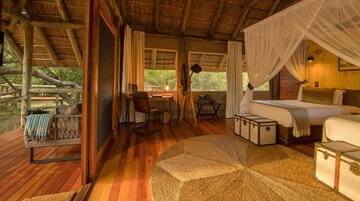
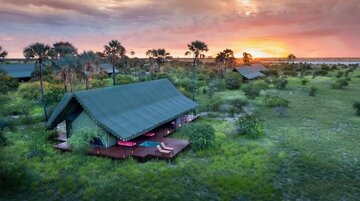
Accommodation in the CKGR ranges from fully serviced luxury tented camps to basic DWNP self-catering sites. The reserve’s remoteness means lodge options are limited compared to Chobe or the Okavango Delta — which keeps visitor numbers low and exclusivity high.
Some of the most respected camps operating in or near the CKGR include:
- Haina Kalahari Lodge — a comfortable private reserve bordering the CKGR, known for black-maned lion sightings and open-vehicle game drives
- Tau Pan Camp — a permanent tented camp on the edge of Tau Pan in the northern CKGR; one of the only upmarket options inside the reserve itself
- Kalahari Plains Camp — remote fly-in luxury; known for night drives and open-vehicle safaris, situated near the pans
- Camp Kalahari — a classic tented camp south of Makgadikgadi with easy access to the southern Kalahari ecosystem; popular for meerkat habituation
- Deception Valley Lodge — boutique lodge positioned near the iconic Deception Valley fossil riverbed; exceptional predator sightings during the green season
Most premium camps are fly-in only, accessed via light aircraft charters from Maun. Rates typically include all meals, game activities, and guiding — expect lodge costs in the region of USD 600–1,500+ per person per night at the upper end, comparable to Okavango Delta pricing.
Is the Central Kalahari Malaria-Free?
The CKGR carries a low malaria risk compared to northern Botswana destinations such as the Okavango Delta and Chobe National Park, where malaria prophylaxis is strongly recommended. The Kalahari’s dry, semi-arid conditions significantly reduce mosquito breeding habitat. However, “low risk” is not “no risk” — prophylaxis is still advised, particularly for the green season (December–April) when rainfall increases humidity and standing water.
Travellers who are particularly malaria-averse (including young children or immunocompromised individuals) should consult a travel medicine specialist and consider South Africa’s malaria-free alternatives such as Madikwe Game Reserve, Amakhala Game Reserve, or the Eastern Cape reserves, where the risk is effectively zero.
What Makes the Central Kalahari Different from Other Botswana Safari Destinations?
Botswana’s safari circuit — Okavango Delta, Chobe, Moremi, Linyanti — is deservedly celebrated, but the CKGR occupies a completely different ecological niche. Understanding the differences helps travellers choose the right destination for their priorities.
| Feature | Central Kalahari | Okavango Delta | Chobe National Park |
|---|---|---|---|
| Landscape | Semi-arid desert, fossil valleys, open pans | Wetland — channels, islands, papyrus | Riverfront, floodplain, woodland |
| Signature wildlife | Black-maned lion, cheetah, gemsbok | Elephant, hippo, aquatic birds, wild dog | Largest elephant concentration in Africa |
| Activities | Game drives, night drives, walking, star-gazing | Mokoro, boat safari, game drive, walking | Boat safari, game drive |
| Access | Fly-in or 4×4 self-drive | Fly-in only | Self-drive or lodge-based |
| Crowd factor | Very low — among Africa’s emptiest reserves | Moderate (varies by concession) | High on riverfront in dry season |
| Malaria risk | Low | Present | Present |
| Big Five? | No (no elephant/buffalo) | Yes | Yes (rhino scarce) |
The CKGR is the destination for travellers who have done the “classic” Botswana circuit and want something genuinely different, or for those prioritising wide-open spaces, desert ecosystems, and exceptional predator action over volume of species.
The San People and the Conservation History of the Central Kalahari
The Central Kalahari Game Reserve has a complex human history that is inseparable from its conservation story. When the reserve was established in 1961, its stated mandate included protecting the traditional hunting and gathering territories of the San people (Basarwa), one of the world’s oldest continuous cultures, who had inhabited the Kalahari for tens of thousands of years.
In the 1990s and early 2000s, the Botswana government relocated the majority of San communities out of the reserve to resettlement villages, a controversial process that was challenged in the Botswana High Court. In 2006, the court ruled that the relocations had been unlawful, restoring the right of San people to live on their ancestral lands inside the reserve. A small number of San communities remain or have returned to the CKGR.
This context adds depth to any visit. Some camps and guides offer insights into San tracking traditions — a form of knowledge accumulated over millennia, and arguably the world’s first and most refined form of wildlife observation. Walking with a San tracker in the CKGR is an experience unlike any conventional safari activity.
Frequently Asked Questions About the Central Kalahari Game Reserve
Is the Central Kalahari Game Reserve worth visiting?
Yes — for the right traveller. The CKGR is not a classic Big Five safari destination; it rewards those who value space, solitude, and desert ecosystems over high game density. If you are looking for tick-box Big Five in three days, look elsewhere. If you want one of Africa’s last truly empty wildernesses, black-maned lions on golden plains, and a sky full of stars with no light pollution, the CKGR is exceptional.
What is the Central Kalahari Game Reserve famous for?
The CKGR is famous for its black-maned Kalahari lions, its vast scale (second-largest game reserve on Earth), its Deception Valley fossil riverbed, its connection to San culture, and its role as the setting for Mark and Delia Owens’s book Cry of the Kalahari. It is also renowned for exceptional cheetah and brown hyena sightings.
How big is the Central Kalahari Game Reserve?
The Central Kalahari Game Reserve covers 52,800 km² (5.28 million hectares), making it the second-largest game reserve on Earth. For comparison, this is larger than the Netherlands, roughly four times the size of Kruger National Park, and about half the size of the United Kingdom.
When should I visit the Central Kalahari?
For the most dramatic wildlife experience, visit during the green season (December–April) when massive springbok and wildebeest herds attract lions, cheetah, and wild dogs to the open pans. For easier game-tracking and more predictable conditions, the dry season (May–October) is excellent — though night temperatures in June–July can drop sharply, so pack warm layers.
Does the Central Kalahari have the Big Five?
No — the CKGR does not have elephant or buffalo, so it is not a Big Five destination. However, it supports lions, leopards, and rhino in some areas, and its predator diversity — including cheetah, brown hyena, black-maned lion, and occasional wild dog — is among the finest in southern Africa. The absence of the Big Five is part of the reserve’s character, not a drawback.
Is the Central Kalahari Game Reserve safe to visit?
Yes, the CKGR is safe for visitors. Malaria risk is low compared to northern Botswana, though prophylaxis is still recommended, particularly during the green season. The main safety consideration is the extreme remoteness — self-drive visitors must carry sufficient fuel, water, food, and communications equipment. Fly-in lodge guests are well catered for with qualified ranger guides.
How much does a Central Kalahari safari cost?
Costs vary significantly by accommodation type. Self-drive camping at DWNP sites costs roughly USD 20–30 per person per night plus park fees. Mid-range lodge options run approximately USD 300–600 per person per night. Luxury fly-in camps typically range from USD 700–1,500+ per person per night on an all-inclusive basis. Park fees for international visitors are in the region of USD 10–15 per person per day.
Can I self-drive the Central Kalahari Game Reserve?
Yes, self-drive is possible but demands a well-equipped 4×4 vehicle, a full fuel load (the CKGR has no internal fuel stations), adequate water and food for your planned duration, and solid navigation capability — there is no mobile signal inside the reserve. The DWNP operates several self-catering campsites at locations including Deception Valley, Piper Pans, and Phokoje Pan. A minimum of two vehicles travelling together is strongly recommended for safety.
Plan Your Central Kalahari Safari
The Central Kalahari Game Reserve is not a destination you stumble into — it requires planning, the right timing, and ideally an operator who knows its rhythms well. African Safari Group, a specialist luxury safari operator, can arrange bespoke itineraries to the Central Kalahari and throughout Botswana, combining the CKGR with the Okavango Delta, Chobe, or South African reserves for a complete southern African journey. Enquire now to start planning your safari.